Black Sunday
Black Sunday
By Thomas Harris
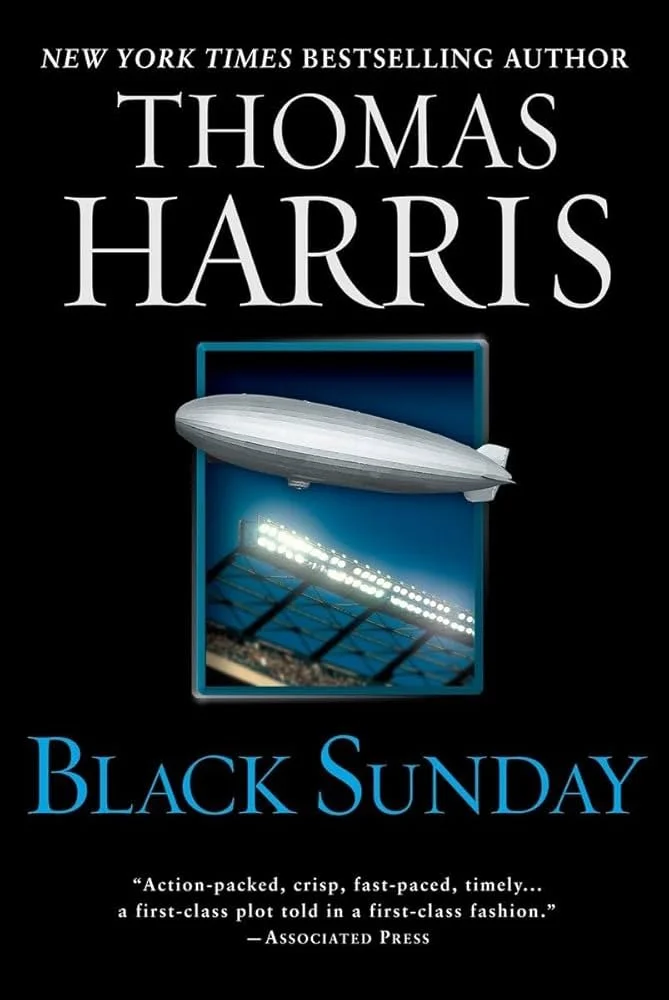
In 1972, the world was shaken with the terror attack on the Olympic games in Munich, Germany. It was probably the first time that terrorism was televised worldwide, bringing fear into the homes of many. And while it remains a tragedy, the event inspired a member of the New York City Associated Press to write a fictitious reflection on terrorism. That man was Thomas Harris, and the novel which resulted was:
Black Sunday.
Many people may recognize Harris as the writer of the Hannibal Lecter saga, but in 1975, Black Sunday was his first novel. It begins with intel on a Black September terror plot to strike fear into the hearts of the Americans, and it evolves into a cat and mouse game between Israeli intelligence and a deeply disturbed American veteran by the name of Michael Lander. Building up to an explosive climax.
I personally always find first novels interesting because of how much they reflect the early talents of their writers. This one is no exception. Harris is known for his rich characterizations, particularly with his antagonists, and he outdoes himself with this one. From establishing a compelling backstory for Dahlia Iyad to fight for her politics to showing the reader exactly how Michael Lander became drawn into her web of crime, Harris spares the reader no sugar-coating. His depictions of their traumas are to the point, to the degree that the reader has no doubt these people are real.
This only serves to further drive his plot, as Harris explores both the why behind terrorism and what terrorism ultimately creates. As Black Sunday builds in its excitement, so does its pain. Bringing the reader into the emotional stakes as the novel approaches Superbowl Sunday. Until it finally all comes to a head, producing an explosive climax.
After first finishing this book, I was surprised that the resolution was lacking. Instead of going the traditional route of bringing the narrative to a clean close, Harris leaves the ending brief and, dare I say, messy. Because it doesn’t offer any kind of solace that things are or will be okay to the reader. Instead, it leaves him with such bleakness that he might stare at the book afterwards wondering, “what happens next?”
But when you seriously consider the theme at work, there’s no other ending that might have been appropriate. By cutting the resolution incredibly short, Harris shakes the reader with a dose of reality. And that truth is that, when the dust settles, there’s only more hurt. That nothing justifies punishing innocent people for injustices inflicted by others. This single notion, combined with its rich characters, makes Black Sunday the powerful novel that it is.
That’s why it was surprising to me that it was only moderately successful in printing, its popularity only improved by its 1977 film adaptation which (in my mind) wasn’t worth writing home about. But if there are faults in this book, they lie in some of the dialogue and the manner in which some of the characters interact. There were times that character reactions and dialogue detracted from their characterizations. Their lines just didn’t do their stories justice. Likewise, some of the interactions, including Dahlia’s presentation of manipulating Michael, read almost like struggles. But given the way Harris’s later work reads, I would say these are first-novel hesitations. If Harris had bothered to take a step out of his own way and allow the characters to talk and interact as they would, Black Sunday could have been even better.
Regardless, this remains to be a hell of a read. I’d recommend this novel to any writer looking to study structure and how to intertwine character with theme. Or to anyone looking for a hell of a good read.