Contact
Contact
By Carl Sagan
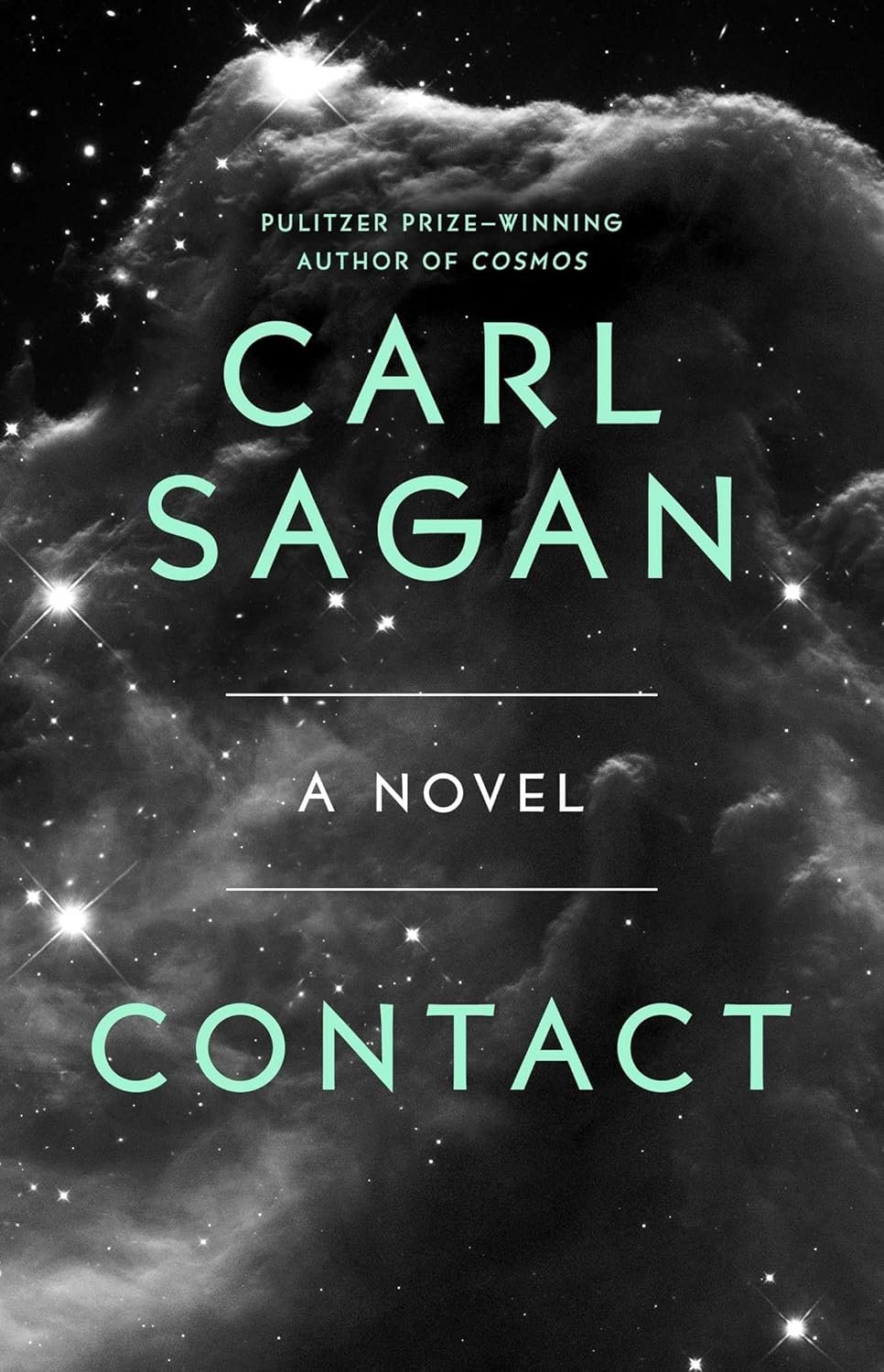
After taking some time to mentally digest the material, I’m ready to talk about the wonderful novel written by Carl Sagan titled Contact. While it remains the only fiction ever published by the astronomer before his death, this novel demonstrates that anyone can write a successful book. It reached No. 7 on the Publisher’s Weekly bestsellers list for the year 1985.
Written as a futuristic science fiction tale about the real implications of contacting extraterrestrial life, Sagan begins with introducing the inquisitive Dr. Arroway. Beginning her story from birth and detailing her climb to work as an astronomer involved in the search for extraterrestrial intelligence, until the moment a message is received from Vega.
I found this novel dense at times, as Sagan packs it with a number of heavy questions while building it as a page-turner. Are we ready for such discoveries as life outside our planet? And if we received a message at the Arecibo Observatory or one of the many radio telescope stations involved with SETI, what should we do with it? Does it disprove religions, reinforce them, or is it completely separated from such a concept entirely? And if does come down to science versus religion, why can't it be both? These are only a few of the many questions this deep novel asks as it takes us through an intense look at our miniscule place in the world.
While this novel is strong in many ways, if there was an issue with Sagan’s imagination, I feel that it was in his perspective of the future. The novel takes place approximately fourteen years after its 1985 publication. Although it’s difficult for any writer to make realistic predictions of the world in any kind of futuristic tale (unless it’s set so far-off into the future that readers don’t have to try so hard to believe it), Sagan makes the mistake of attempting to awe his readers with dazzling new technologies that are too futuristic.
The effect is that his efforts detract from the believability of the text. Making the experience of his science fiction more outrageous than real and taking away some of the power of his words. However, we must remember that Sagan was a scientist first and a novelist second. Many writers (myself included) struggle with attempting to capture a picture of a world where reality hasn’t (chronologically) caught up to it yet. And also, Sagan’s efforts as a novelist were only because this work was originally conceptualized as a script for a film which later was dropped. It would be years following its 1985 release as a novel until it would reach the big screen again.
Overall, for his only work of fiction ever written, this novel was truly impressive. I would not hesitate to recommend it to anyone looking for a hell of a literary ride or anyone looking for inspiration that anyone could be a novelist with enough dedication. Contact by Carl Sagan is, without a doubt, the kind of book I would love to read again.