Drood

Drood
By Dan Simmons
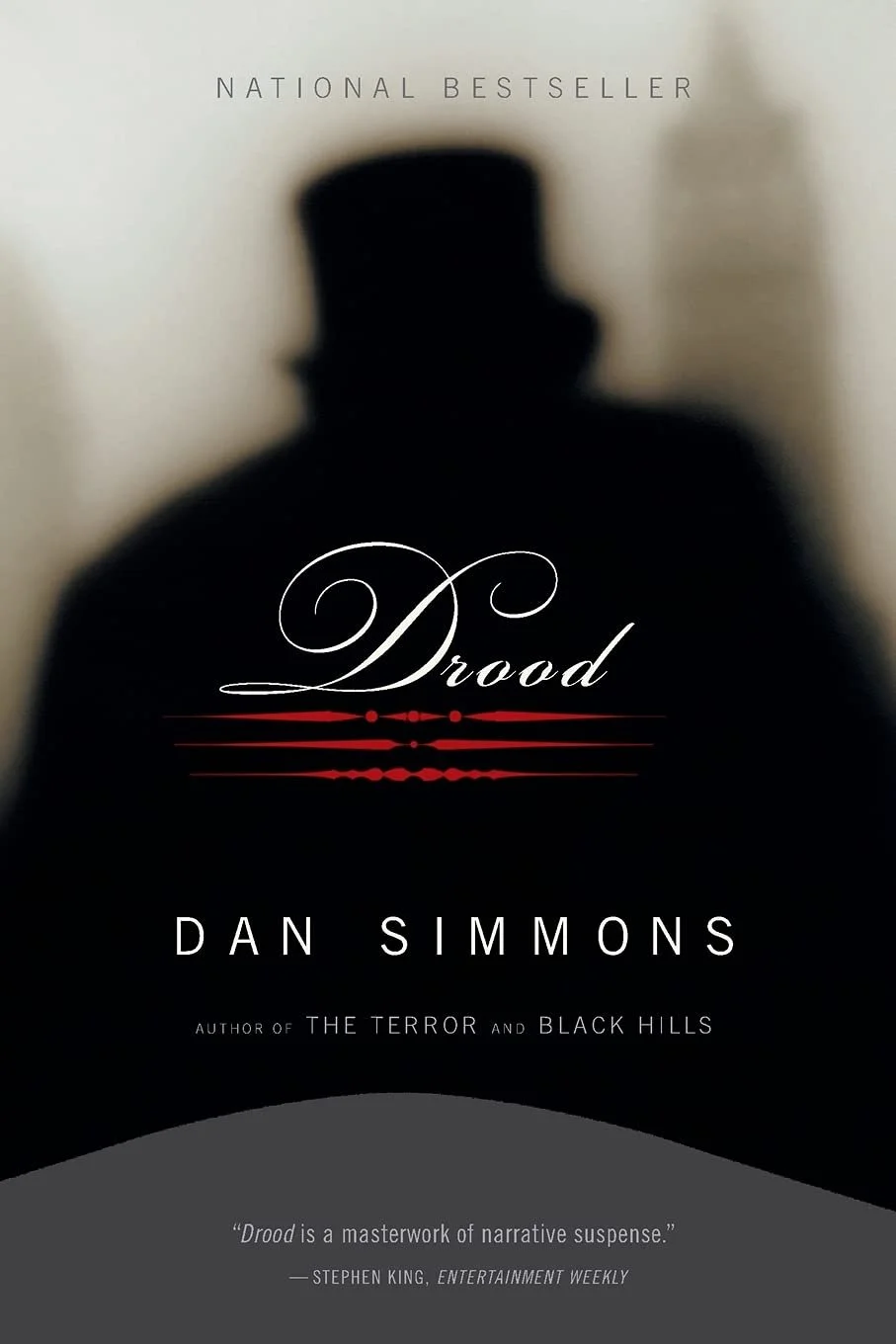
In my efforts to explore more horror fiction, I just finished reading Drood by Dan Simmons. For those unfamiliar with this novel, perhaps you may know of the last novel by Charles Dickens—The Mystery of Edwin Drood. The title is a reference to that book; this novel is a fictionalized account of the last five years of Charles Dickens’s life with a horror genre spin on some factual events.
This was my first-time reading Simmons, but I can already say that it won’t be my last. What Simmons manages with the blending of history and horror is only something I’ve seen done with one other writer thus far—Caleb Carr. And to successfully center his work at the precise intersection of historical fact and fictional story (the writer’s world and wishes for it) is no easy feat. Whereas a conventional novelist, whose work is completely a creation of the writer’s mind, may manipulate the text and characters however he desires, the historical fiction novelist must operate within the confines of what actually happened and what people were actually involved.
It’s essentially a juggling act.
While the writer can certainly still bend history to suit his needs, there’s a limit where the historical events will break the reader’s belief in the story if it ventures too far off course. At the same time, his cast of characters is already presented to him, along with their characterizations as long as the writer is dedicated to his research. But this also requires a lot of research and restricts the writer to using characters he may not like on the surface, with only a short amount of leeway where he may bend them to suit the needs of the story he wishes to tell. And while the ending is almost decided for the writer, the story has to still work with what actually happens.
It’s for this reason alone that I’ve never attempted to write historical fiction, especially any historical fiction story which utilizes real-life people. I don’t feel I could stick to the rules of history. Simmons’s mostly-successful attempt in this case makes this book proof of his skills as a writer. The entire concept of Drood as a novel is ambitious and has so much potential that it could have been so much more.
As a writer, I wanted more than it had to give. It opens as a frame story, its narrator—a writer friend of Dickens named Wilkie Collins—sharing this novel as his account of Charles Dickens’s dealings with a phantom named Drood throughout the last years of Dickens’s life. And while Simmons manages to capture the feel of a Victorian novel in his narration style, I’m not convinced that it fully works as well as it should. The novel is wonderfully detailed in its research—to the point that you can almost feel the writer’s excitement having learned so many different facts about the people he’s talking about—but several times, the writer allows his level of factual detail to interfere with the story.
In his craft book On Writing, Stephen King mentions that a writer’s job is to tell the story and keep it going. To extract it, he explains, as if it were a fossil being unearthed for display in a museum. Simmons veers off course from this task by delving into pages-long backstory side-tangents that, while interesting, don’t influence the plot enough to justify their word count. Part of the art of storytelling is to balance information to make the reader believe in the characters as if they were real people and to keep the story moving. Simmons offers some truly amazing scenes and moments of creepiness throughout the work, but for a horror novel, I needed more of it.
Likewise, while I loved the descriptions and diction, I felt like its focus wavered a bit. Although Simmons was attempting to establish doubt and set Wilkie up as an unreliable narrator, I was hoping he’d play around with that more. He did towards the climax, but I would have enjoyed seeing more of a progression of that to further sell me on his state of mind. What’s real and what’s not? This is yet another truly ambitious effort made by Simmons, as he took the complicated already and thus made it even more complicated. But if he had turned that up just a little bit more throughout the book, I think it could have been even better.
While the focus was affected, so was our antagonist. Drood is a character rich enough in potential that this novel is named after him. So why does it feel—even partially—at times like his motives are unclear? I understand trying to fit a villain’s nature to the kind of Victorian tale you’re telling, but it almost didn’t feel enough. Kurt Vonnegut once said that every character should want something, even if it’s a glass of water. With this logic in mind, in order for an antagonist to function in story, there has to be a desire there. I wanted a little more clarity on what darkness this character represented in the text. What he wanted. What was suggested that Drood wanted didn’t feel dark enough to warrant the building tension.
It’s my take on this novel that Simmons overwrote the book. I think if this had gone through another round or two of serious edits—cutting or at least condensing a quarter of its 800 pages—Simmons would have had a more powerful novel that would have been a page-turner. Despite this issue, I still found it richly beautiful for its potential and incredibly ambitious. I loved the darkness of the ending and felt that it was the kind of resolution which sticks with a reader long after they’ve finished the book. As if Simmons were awakening the reader from a dreadful nightmare. That, once again, is no easy task and the mark of a novelist who is truly gifted.
I’d like to recommend Drood by Dan Simmons to anyone who is potentially interested in the study of novel writing or enjoys creepy Victorian literature. The writing alone is truly dark and brilliant. My interest is already piqued to see what surprises might be in store with Simmons’s other novels.