Revival

Revival
By Stephen King
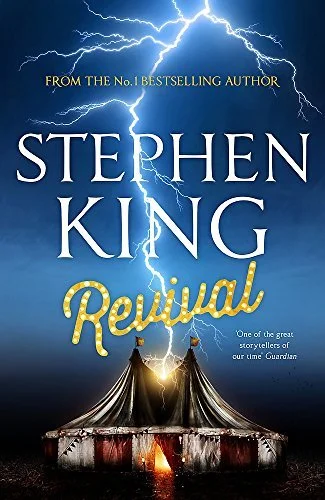
While I’ve been in a fresh writing storm lately, I also took the time to read Stephen King’s novel Revival. Although I like to think of myself as something of a writer historian with King being one of the subjects I study most often from a craft point of view, I admit that this book is the first novel of his that I’ve read which was written after his famous accident.
For those unfamiliar with what I’m talking about, Stephen King was seriously injured after being struck by a van while jogging in 1999. He has (thankfully) made a full recovery, but ever since his traumatic experience, there have been some readers under the impression that his approach to his craft has changed.
I don’t have enough data yet for me to be convinced one way or the other about any possible change in writing style. Even if I do believe that certain things we live through can reshape our outlook of the world. But two questions did cross my mind while reading this book: 1. Is it possible for a writer to become exhausted after decades of storytelling? 2. Would writing a book like this—which deals so closely with the afterlife—be a way of working through great tragedy for someone? I can’t answer either one; they’re questions more appropriate for the writer themselves. Even if they were interesting to consider, briefly.
I can say that my experience reading Revival was slightly different than any of the older works I’ve read. The novel begins with a very clear-cut literary coming of age story that, to me, was richly dark and beautiful. The characters had that sort of classic King depth to them that you couldn’t help but feel for them by the third chapter—when things started to get really heavy.
But then it changed.
I don’t mean changed gradually; this novel seemed to change rapidly. King took a sharp right with the tale, drawing it deeper into a science fiction/horror novel as it accelerated through the years to repeatedly reunite the protagonist, Jamie, with his antagonist, Charles Jacobs. This choice of direction made the book come across as jarring, as it built some excellent tension and interest up until the middle of the book. Only to squash it as the story slipped further and further into absurdity as it played out. It was my impression while reading this book that King might have put it away after writing a portion of it and tried picking up later where he left off.
Specifically, I had the most trouble with the Charles Jacobs’s character arc. In fiction—especially when writing anything with a drastic change—you want your readers not only to like your characters. You want them to believe them. While I believed in Charles Jacobs as a man up until the third time his path crossed with Jamie (in Colorado), I found it too absurd to believe him as a character as the novel built towards its grand climax. Something about the result of his characterization—to me—just seemed too neat after one tragedy. Whether that’s because the protagonist seemed to endure more tragedy throughout his lifetime or because the reader is only offered brief interludes with him, I can’t say for certain. But if you’re going to drastically alter your character, you better have enough believability to back it up. And if you’re going to complicate the conflict, it’s a good idea not to make the vehicle of doing so too apparent.
Speaking of neatness, however, I found the climax a bit too neat too. Although the trajectory of the horror elements indicated this one might go something like Frankenstein, I found the exciting close of the climax a bit too coincidental. That the protagonist had exactly what he needed at exactly the proper moment—making it unbelievable. Perhaps this feeling comes from an area of disappointment, as King’s earlier works rarely seemed to give the protagonists anything that might be useful to help them weather the final climax—making the reader wide-eyed, holding onto the book for dear life till it was finally over.
I still enjoyed Revival even if it wasn’t quite what I was hoping for as a King novel. I found the literary passages intermixed throughout darkly beautiful, poetic, and insightful. I also loved the portion of the novel which took place in the 1960’s, including Jamie’s progression into becoming a musician. There are some brilliant uses of condensed time, demonstrating how a writer might cover a span of twenty years in a short amount of paragraphs.
Overall, I feel this novel would have been better if written more as a coming of age story and the horror novel sections extracted and written as a separate work. I feel like it would have been smoother and more engaging for the reader. And I feel like the literary portion could have potentially been prize-worthy. Regardless, Revival remains an interesting work of fiction that I thoroughly enjoyed reading. I’d like to recommend this book to anyone interested in thematic passage writing and character development.
I’m interested to see how some of his other newer works compare.