Julia
Julia
By Peter Straub
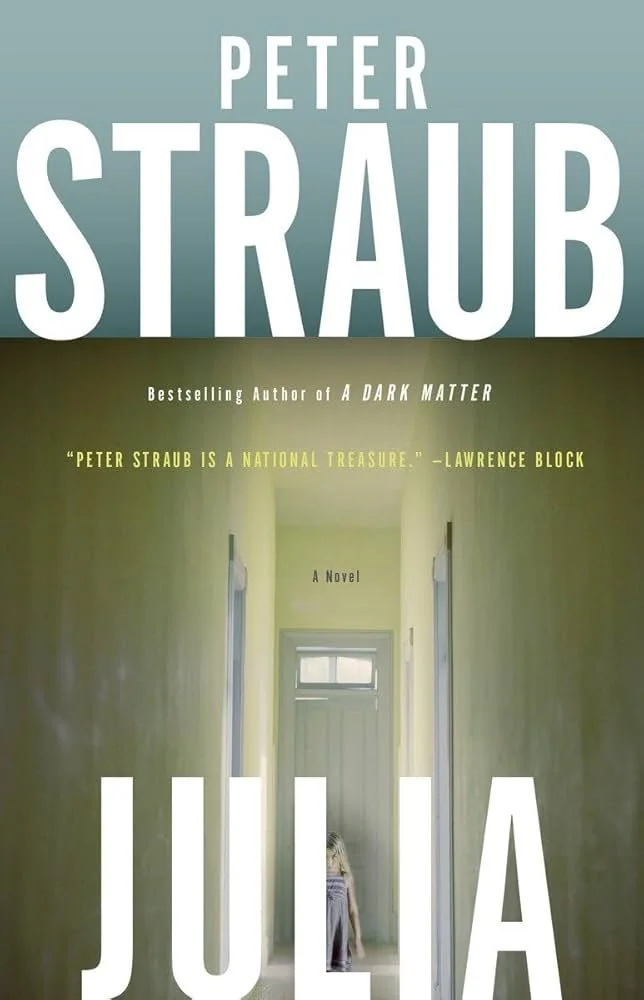
Once upon a time... There was a struggling poet named Peter in the early 1970's. Peter was an interesting character. An American born in Wisconsin, Peter had carried around this heavy consciousness of his own mortality since he was seven years old, when he suffered a horrific accident being struck by a car and needed to completely relearn how to walk again. While he managed to publish two collections of short stories, Peter pivoted to try writing historical fiction, where he published two novels which did not sell well. After yet another rejection, Peter's agent finally suggested he might try to channel his feelings of mortality and his poetic abilities to try writing a gothic novel. That novel, published in 1975, went on to eventually become a major motion picture (entitled Full Circle) starring Mia Farrow and established his third-writing career, this time as a horror novelist.
The novel's title was Julia, and Peter's last name was Straub.
While I try to typically separate a writer from his work—especially while I’m reviewing it—I think there’s definitely a lot you can infer about a storyteller from the stories he writes and the way he crafts them. In the case of Peter Straub, I had always suspected some form of interest in poetry from the way he approaches a tale. And Julia is no exception.
This novel is written in a rich and alluring style of prose which beckons the reader in from the opening paragraph. Ensnaring their attention and gradually leading them deeper into its mysteries with Straub’s delicious use of vocabulary. Until, at last, the reader finds themselves along for the ride. It’s clear that Straub’s keen eye for poetry was applied painstakingly to every page, as its descriptions read almost like ominous prose poems. There were more than a few subtle, one-line moments in its craft that I found myself rereading aloud just to hear the dark and silky flow of the book.
This manner of writing was very effective in establishing the overall dark feel of a horror novel as well as in characterizing most of the major players. While the novel’s protagonist—Julia Lofting—was clearly defined from the beginning, so was her husband, Magnus. Their characterizations actually played off each other quite beautifully. The dysfunctional dynamic of their marriage established quite a bit of the backbone for this dark tale, demonstrating how an important relationship may be given weight by a writer to help shape the overarching story being told.
Where I felt Straub struggled, however, was with Magnus’s siblings—Marc and Lily. Their characters seemed shallower than fully fleshed out, as if they might be mere devices for shifting the plot from one point to the next instead of actual players throughout. There were a few times that I found myself questioning why their characters would act in certain ways if they were meant to appear like real people in the novel. I also found Lily’s relationship with her brother—while unique—slightly disturbing given the dynamic implied by the text. While it wasn’t outright spelled out, I felt there were more than enough context clues to lead a reader to assume something a little bit more screwed up than just love for her brother.
These minor inconveniences aside, my biggest issue was, perhaps, with the connection to the supernatural and the antagonist’s desire. Kurt Vonnegut had once said that every character should want something, even if it’s only a glass of water. While Straub certainly did a fine job of establishing motives and connections in his living characters, his supernatural antagonist I found difficult to connect with Julia. Since I had trouble with that connection, like a domino effect, I also had trouble with the antagonist’s motive. It would have made slightly more sense if the connection and focus of the story were slightly shifted to a different character. This annoying issue which detracted from my immersion in the story eventually made it that the climax had a little less power than I would have enjoyed.
Despite these short-comings, however, I felt that Straub more than made up for himself with the side-plot. Although side-plots can be difficult to pull off from a writing perspective because they’re either lost in the shuffle (and are never resolved) or become so large that they overshadow the main conflict, Straub’s efforts in Julia were bold and paid off. He effectively married both plots together that they ended up working together despite their differences. This created a sense of splendid wonder for the reader where they wondered what was real and what was fabricated out of familial dysfunction. Making them question if they could truly believe the protagonist the way a novel normally requires. This kind of careful plot structure is no easy task, especially for an earlier novelist, and it marks the skill of an exceptional writer.
In conclusion, while Julia certainly has some plastic faults to it, it remains a lesser-known, earlier gem that highlights the promise of a talented storyteller. No different than any successful writer’s beginning works. I truly enjoyed this novel, and I would like to recommend it to any writer looking to study how to appropriately establish a successful side-plot or how to write a story where a relationship provides great importance for overarching context. I’d also recommend it to anyone looking for a damn good story or simply for some dark and poetic writing.