'Salem's Lot

‘SALEM’S LOT
By Stephen King
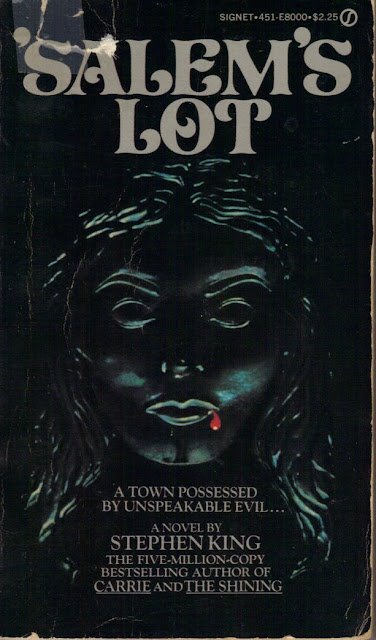
The Fall season of 1972 was a turbulent time for the United States. While peace talks were taking place about the Vietnam War, most of the United States citizens were glued to their televisions watching the developments of the Watergate Scandal. And that same season, a small-time writer slash high school teacher in Maine taught Dracula to his students, where he started to wonder how different the novel would have been if Count Dracula had shown up in present-day USA. He voiced the question aloud to his wife over the dinner table, where she answered his question by saying, “He’d probably get hit by a yellow taxi cab.”
But the question festered, narrowing until it became more-specific: What if Dracula came to the USA—not to a big city but a small town? And he set to work to answer it himself, writing through it for three years until 1975, when he finally had his answer.
And ‘Salem’s Lot was thus created, establishing Stephen King as a star on the rise.
Reading this novel over, it’s no wonder it gained such enormous popularity. Told as a retelling of the canon vampire novel, ‘Salem’s Lot follows a haunted writer who returns to his childhood smalltown to banish some awful memories and the dark occurrences which begin to unfold with the arrival of some mysterious Europeans. From the opening prologue, the reader is thrust face-first into the novel’s mystery with a horror story which sinks its teeth in and doesn’t let go until well-after the closing line. King portrays a cast of well-sculpted characters who are distinct from each other enough that they’re both memorable and believable. And, in doing so, he shapes a well-crafted setting which is just as much of a character as anything else. He uses these people’s characterizations—the little snippets of gossip about them and their darkest secrets no one else knows—as the foundation for the construction of a town that is a lightning rod for darkness.
How do we decide what places are evil? Contrary-wise, is there such thing as an evil place—or only just a place which seems to attract evil? King both poses both the question and the answer with some truly dark and decadent thematic passages contrasted against descriptions of terrible events. The result is that ‘Salem’s Lot is a beautiful novel of life and death, built in with enough emotional depth that the reader feels every pierce of the heart. I found it difficult to select just one favorite character out of his rich cast. Besides Ben Mears, I loved the way King fleshed out Jimmy Cody, Susan Norton, Matt Burke, Mark Petrie, and even Father Donald Callahan. All of them were the kind of character which seemed to live and breathe freely, allowing the novel to take life as much as anything.
Where I felt King struggled, however, was with the characterization of Kurt Barlow. While the events of the story serve to hype him up, I found his own characterization to fall slightly flat because, in my way of thinking, King didn’t have enough fun with him. For anyone who has ever read his first novel, Carrie, or even some of his later works, you understand that King has a dark knack for allowing characters to transform from good to evil. He brings them full circle in such a way that the reader buys it hook, line, and sinker. But what of a character whose darkness and evil is already established? What then? If evil is the base-line, then it’s good practice to pose some form of elevation. Make the antagonist grow darker—some form of change worthy of the story’s movements. While King attempts this (and is moderately successful), he could have easily been more successful (more believable, I should say) if he had bothered to have more fun with the star of his darkness.
I chalk this fault in his novel up to a learning experience for a young, promising writer. Especially given the fact it’s something he learned from when crafting another novel, The Stand, only a few short years later. The secret no one tells you—no matter if you’re young and starting out or well-established—is that no writer ever gets everything right. But the mark of the truly gifted are the ones who can learn from their own work as well as the work of others. That’s what I believe in my heart is the case with this writer’s future.
‘Salem’s Lot is the kind of well-written novel that, I believe, is unlike any novel King has ever written (or would write in the future) because of this. His words are rich and alluring but carry with them the passion of a young, driven writer with something to say that’s ready to burst through him. And the way King created such a dynamic world within his pages to unleash his thematic fire and fury with this one almost speaks to a man saying goodbye to his modest upbringing. This is truly a special book, folks.
I’d like to recommend this novel to anyone interested in characterization, specifically how to construct a place as a character of its own. This one was a wild read for me, but I feel like it’s taught me a lot about the different methods to establish character. I hope whomever reads it loves it just as much as I do.