Murder by Cheesecake

Murder by Cheesecake
By Rachel Ekstrom Courage
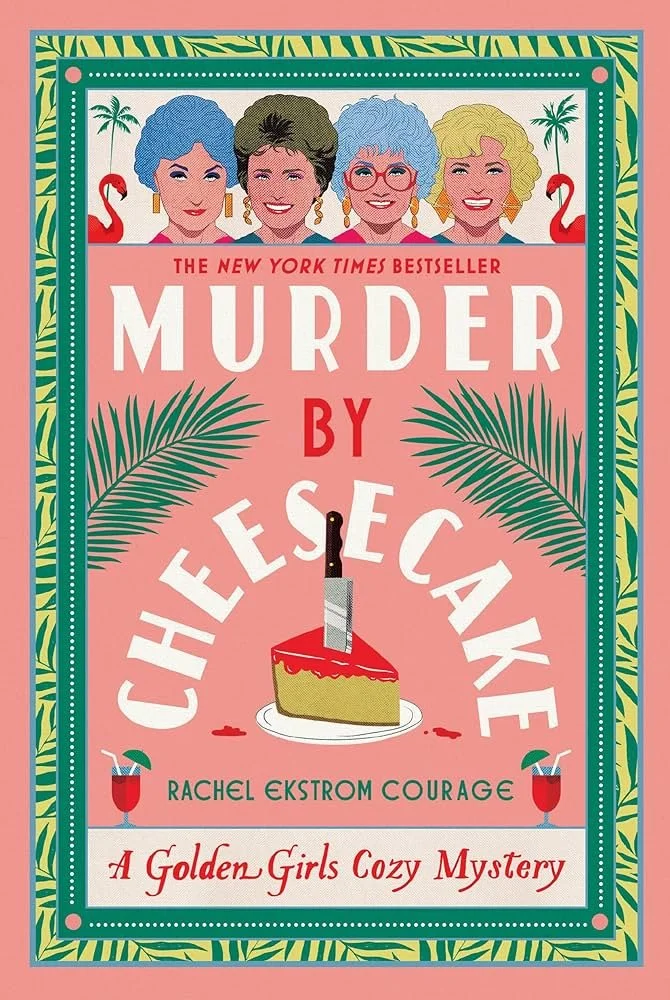
I decided to take a short break from reading darker fiction to enjoy something a little more light-hearted. For my latest literary adventure, I chose to delve into Murder by Cheesecake by Rachel Ekstrom Courage—a cozy murder mystery story loosely based on the characters from the classic television show The Golden Girls. And while I found it amusing, I discovered just as many issues with it as I did pleasant surprises. I give lots of credit to the writer. I can appreciate how intense pulling off this project must have been.
For those who live under a rock and don’t know how wonderful the series is, The Golden Girls captured the life and times of four middle-aged women sharing a house together during the eighties and early nineties. It was a show which subtly tackled current issues and morals of the time-period with a clever comedic edge. Despite all cast members being sadly deceased, it’s a show which still has an immense fan-base of people from all walks of life. Ekstrom Courage’s novel boldly attempts to capture the nuances of the characters and place them in a murder mystery novel framework. It’s around 1986, and Rose Nyland is under extreme pressure to throw the most traditional St. Olafian wedding for her distant cousin when Dorothy’s obnoxious date is discovered murdered in a hotel freezer. And that’s just the beginning. With clashes of tradition and the more modern eighties style, more than enough upset wedding guests, and Dorothy being suspected of murder, the four women must try to both solve the crime to clear their friend’s name and somehow find a way to hold the wedding together.
It’s a cheesecake recipe for disaster.
I truly love the creativity this writer possesses. Not only did she have the guts to take a very popular household series and choose to create something a little different with it, she also tried to ground the reader with more than enough believability built upon knowing the most finite details of the show. As someone who binge-watched this series more than a few times during undergrad (and, I admit, even years later), there were a few times Courage impressed me with her eye for detail. From costumes and props featured during different episodes to even their home address, Courage earns honors for her commitment to fitting the story as closely as she can to the show. I respect her level of dedication and can only say that what she’s done was no stretch of the imagination a small feat.
That being said, while the concept is enjoyable and must have taken her ages to craft, there are a few things that I found cumbersome with this novel. Going back to believability and the feat that Courage undertakes in writing this book, it’s truly difficult to artfully capture the scope of what’s already established. Unless you’re one of the original screenwriters or creators of the concept you’re trying to pair a new story to, it takes an intense amount of imagination to consider exactly how characters might present in your new story while not making it a re-hash of what’s already been created. For example, James Bond was originally a novel character written by Ian Fleming. Since his death in 1964, several other writers (including John Gardner) have written Bond novels of their own with more modern twists. And they’ve made their money off it. Many enjoy them while others find it difficult to believe their portrayals of the star character. That controversary is why I refuse to ever read any Bond novel not written by the original author. I just don’t want to potentially disappoint myself if I’m one of the few who don’t buy into that writer’s portrayal of Bond.
Courage’s novel attempts to walk the fine line of trying to accurately portray beloved characters people have watched again and again. She’s attempting to anticipate what kind of spicy dating story Blanche might share or how Dorothy might feel about her own love life. All to ground her readers in believing in the characters. Then to make matters even more complicated, she’s trying to maintain the show’s comedic wit to keep it both believable and enjoyable for the reader.
And this is where Courage’s house of cards caves in for me.
Despite one or two great one-liners thrown in here and there, the hilarious banter read more like forced comedy than anything. The character reactions to the story’s circumstances read to me like directed portrayals instead of allowing the characters to live and breathe. This I blame not on the writer but all of the odds that are against her because it’s traditionally very difficult to pull off jokes in novel writing. A clever piece of dialogue or wit might make a reader smile here or there. But more often than not, no one will be laughing while they read the book. That’s why one of my cardinal rules when writing my own work is to almost never do it. And let’s not forget how large of a presence these characters already carry on their own. If she had allowed them to fully live and breathe within the scope of the novel, I doubt the end product would have resulted in a murder mystery at all.
Still, when it comes to the workings of the other elements within the story, I think Courage could have benefited from a closer look beyond the main characters. Her secondary cast of characters—especially Nettie and Jason—I found to be troublesome in their characterizations. Although every secondary character serves as a specific mechanism for propelling the plot along, there was hardly any depth to them. This made them come across more like caricatures instead of actual players in what should be a complicated plot.
Likewise, I found a few of them to out of place in 1980’s Florida, as their views and portrayal speak more about 2026. This is an issue I’ve found before with some other period pieces, primarily within historical fiction. The good writer may produce tension by dropping a character with more forward-thinking values into a work which hinges on a specific time-period (in this case, 1980’s Miami), but a truly gifted writer does it in such a way that they’re subtly intermixed among the rest of the cast. This makes their moment where their views are shared more insightful and ponderous rather than appearing as a not-so-subtle talking point akin to a soap box. This again, like accurately portraying someone else’s character vision, is a truly difficult task to master if you don’t want to jar the reader out of the continuous dream of your story. It’s something I even struggle with myself. That’s partly why another cardinal rule of mine is to stay away from history (except, sometimes, I break my own rules, but we won’t go there).
The most troublesome feelings I had, however, surrounded the climatic moment. Now, bear in mind that our primary cast of characters are somewhere around their sixties with Sophia being the oldest in her group (probably eighties). And this novel is a murder mystery. That means there can be some level of danger, but it can’t necessarily be anything on the level with Stephen King’s climax in The Shining. Although it might be entertaining for the sheer nonsense of it, that level of violence would obliterate the comedic element and absolutely traumatize every single character in the novel (and perhaps some of the readers too). So, Courage has to delicately balance comedy and danger. And for me, it was sadly too imbalanced.
When I think of novels that have to balance light-heartedness and danger, I like to think back on a children’s literature class I had to take in undergrad. I walked in thinking that the course would be writing stories that were always sunshine and rainbows. Our professor taught us that, in reality, what you write can be a little more complex if it’s artfully balanced. We read excerpts and summaries of middle-grade and young adult novels. Some of them tackled issues like drug abuse, murder, rape, and kidnapping. She explained to us that because many people believe children’s literature is just sunshine and rainbows that, sometimes, certain concepts that are explored within the confines of that specific genre fly under the radar with adults and teach children some of the tough realities of life on their terms. That the writer often has to be delicate with how they handled the mature subject matter they include so it doesn’t alienate the genre (and their audience).
The same rules apply, I’d say, for when you’re writing a funny murder mystery or a murder mystery aimed at an elderly audience. Stephen King wouldn’t create a funny murder mystery and might give elderly folks a heart attack. But with too little danger involved, the climax—the moment of your plot’s intensity—falls flat and becomes anticlimactic. I feel Courage could have added a greater degree of danger while not allowing the mystery to drastically alter the kind of novel she set out to write. If she had done that, it would have made an alright novel a better novel because it would have ended with a sense of progression rather than stagnation.
All things considered, I have nothing but respect for this writer’s courage in attempting what no other writer has attempted before. It was a challenging undertaking that I think many writers would have struggled with (myself definitely included). There’s a good chance that I’ll probably read the next one at some point. But for now, I’d like to recommend Murder by Cheesecake by Rachel Ekstrom Courage to any writer seeking encouragement in how to be bold and break the rules. And any writers who wish to study the delicate balance of danger and humor in the realm of a murder mystery.