A Short Stay in Hell

A Short Stay in Hell
By Stephen L Peck
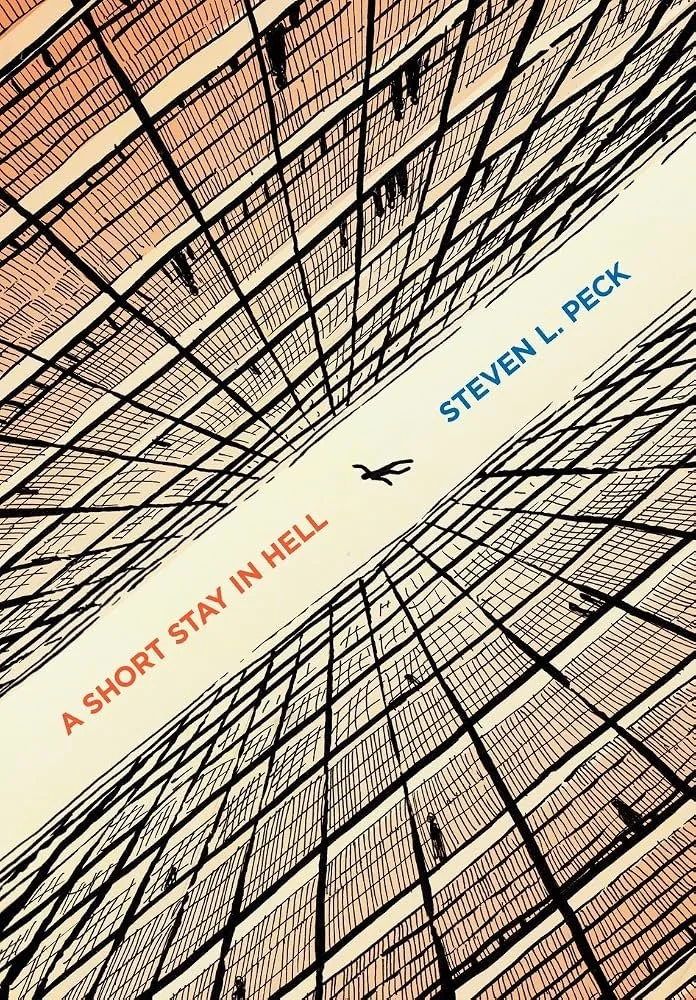
In 1941, an Argentine writer named Jorge Luis Borges published a short story about a universe consisting of endless networks of hexagonal rooms containing every book that could be written known to man. It was called “The Library of Babel” and achieved notoriety as a meditation on the search for meaning and the meaning of infinity. Over sixty years later, an evolutionary biologist (and writer) was so inspired by the story and his own late-night existential wonderings about eternity that he decided to write a novel. He took care to make it his own, conceiving such a place to be a personal form of Hell while he explored the concept of the afterlife. And in 2009, Stephen Peck’s novel A Short Stay in Hell was finally shared with the world.
I admit that I first heard about this one from some social media book recommendation videos, and I have to say that I thoroughly enjoyed it. Peck’s novel contains the kind of precision where you can tell it was written by someone with a scientific background. The details are carefully calculated. The questions and arguments are paired evenly with counter-arguments and even more questions. It’s a novel where the writer does not waste time. And the result is that it packs a powerful punch that leaves its readers in awe.
For those unfamiliar, A Short Stay in Hell by Stephen Peck opens in Hell. A geologist named Soren has been sent there along with other strangers, and each person is assigned their own specific, temporary version of Hell. For Soren, this is an infinite library containing every book that could be written and being tasked with finding the one book which contains the story of his life from start to finish without any spelling or grammatical errors.
And that’s just the beginning.
This was one I couldn’t put down. From the start, Peck takes a traditionally cliché concept and flips it on its head. Not only does this jar from early boredom, it actually locks in their attention with a delightful surprise. But this isn’t the last. It’s rather only the first of several wonderful moments where the cliché becomes twisted into something truly unique. In doing so, Peck takes the tired-old concept of eternity and gives it emotionally gut-wrenching ruminations in new ways.
But concept is not all this novel carries. As I’ve stated before, this book wastes no time. Every scene functions with a fine-tuned purpose of engaging with the theme. And every shift in characterization closely engages with the thematic pattern. This leaves the reader feeling the weight of eternity and the hopeless despair of searching for meaning. And its ending is a powerful and beautiful experience which ties everything together so tightly that it leaves its reader unsettled in the worst ways. After this book was over, I actually sat with my thoughts for a while, considering both what really happened in the world of the novel and the reason our population is so fixated on eternity.
It’s a gut-wrenching burn.
My only criticism is in the length. While this tale functions like a lean machine, I typically find shorter novels to present quick changes to characterization. This isn’t to say that it’s unbelievable, but it creates a scenario where the reader has barely settled in with the character before the metamorphosis begins. Although years had passed within the story, there were times when Soren’s character seemed to alter quickly because it was a matter of a few short pages. But to add any length to smooth out the character arc would detract from the sharp point the book is making. So, while it’s a trade-off, I’m thankful that Peck made the choice he did. I think it was the right move given the options.
For those looking for a concise horror story, you can’t go wrong with Stephen Peck’s novel A Short Stay in Hell. I’d like to recommend this book to any writing looking to study the art of brevity with particular attention in how to appropriately marry your theme to characterization. This was my first Peck work, and I can confirm it won’t be my last. I look forward to exploring his other work.