The Handmaid's Tale
The Handmaid’s Tale
By Margaret Atwood
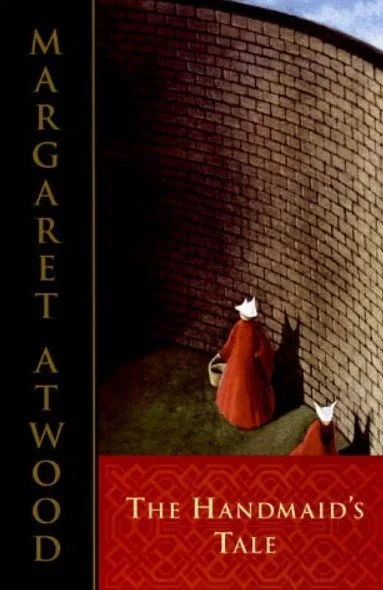
For my latest literary adventure, I was torn about what to read next. Ultimately, after a long gaze at my to-be-read piles, I decided to go with something I’d read before but didn’t truly feel I appreciated at the time. That novel was The Handmaid’s Tale by Margaret Atwood. And I want to say I appreciated it more this time because I wasn’t staring down the barrel of an undergraduate essay or thinking about a reflection blurb to discuss with a graduate professor. This time, it was just the novel and I—the way I prefer any reading.
For anyone unfamiliar with this book, it’s a 1985 dystopian speculative fiction story about a theocratic state being erected in a future United States, where sex for pleasure is outlawed and women are viewed as property. Inspired by the real-life Iranian regime constructed in the late 1970’s, it explores the close personal experience of the protagonist Offred in a scenario where her body is considered government property.
Having read this book before, the plot was no surprise to me. But the style and setup of Atwood’s novel I found jarring and better than I remembered. While this novel is told in a close first-person manner with a multitude of flashbacks to compare the present to the past, I found it sometimes tricky to get into. But with being more patient now than when I was a college student, I just took a little more time to go over a few pieces again before I was finally able to settle into its style.
I like to bring this up because I feel it’s important to note there are some books you’ll want to read merely for the entertaining experience while there are some books you’ll want to enjoy merely for the artistic experience. I feel like Atwood’s book falls into the latter. It’s beautifully written with incredibly constructed thematic passages. But if you’re expecting a story which a lot of action (such as a traditional structure moving from A to Z), I don’t feel like you’ll be able to truly appreciate it for what it is. Like all clever art, it requires patience and time to understand. The Handmaid’s Tale is no exception.
The structure to this novel is a slow burn, but its thematic experiences of human life as property and the idea of carnal pleasures being transactional in their nature, I found truly interesting. Atwood gets an A for her keen attention to detail in depicting the human experience of someone so closely monitored. Her protagonist has a rich character backstory which only reinforces the themes at work because her life before almost represents a direct contradiction to her life at present.
At the same time, I found the contradictions built into the fabric of both her society and the secondary cast of characters equally interesting. While I won’t spoil it for anyone (I hope others will wish to judge this book in their own eyes), I felt like the society itself and human nature throughout were as much of characters as the people Atwood wrote about. I would say that probably my favorite portion was the last third of the novel because it not only got more into the heart of action but also talked more about what transpired to being about this dystopia.
While I feel this novel is largely successful, I will say that I wanted more from the backstory. To give some perspective, this book was one that made Atwood start carrying around newspaper clippings just in case someone she met on the street might offer some kind of criticism that a Iranian-esque theocratic regime could “never happen” in a first-world country. Her argument was that this novel’s very existence was an argument that it could. And, overall, my experience reading this one was just that there wasn’t enough of the backstory artfully interwoven for the writer to make that kind of claim. There are dozens of dystopian novels on the market; while they could be considered “warnings” by their very nature, there are more than a few I would say are true stretches of the imagination (The Running Man and Hunger Games among them). Furthermore, while Atwood successfully constructs a close lens of the everyday experience throughout this novel, I almost wanted the manner in which Gilead is established to be a bit weirder. Perhaps even closer connected with the thematic patterning at work than it already was.
Regardless, I’m willing to chalk my criticism up to “you can’t have everything” simply because such changes might have drastically altered the artistic experience at work. It’s important for any writer to choose what’s most important when constructing a story. In this case, I feel like Atwood’s work is largely successful in its cause. The thematic patterning is only proof of this, being both beautiful and tight.
I’d like to recommend The Handmaid’s Tale by Margaret Atwood to any reader open to a slow burn that packs a hell of a punch. Or any writer interested in the relationship between character and theme, specifically how you can adapt your setting into being an important character by itself. This being my third attempt reading it, I can safely say I truly appreciate the art of this novel. And I’m interested to know what the long-awaited sequel might have in store.