Sphere

Sphere
By Michael Crichton
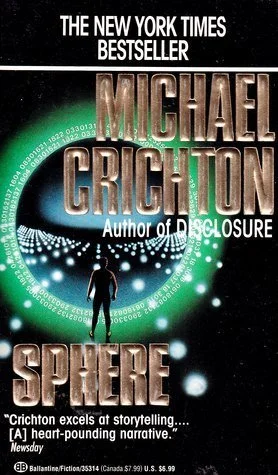
In 1967, Michael Crichton decided to embark on a tale about a 300-year-old alien spacecraft which comes to Earth with stenciled words in English on its sides. He originally intended this piece to be a companion to his novel The Andromeda Strain, but unfortunately for Crichton, he couldn’t figure out where to go with it. So, like many writers have done before him (and many writers since have done), he decided to put this novel-in-progress aside until such a time he could figure out what kind of story exactly he was attempting to write. It would be twenty years until it would find its way into print.
This novel was Sphere.
I always find it intriguing the backstory behind some writers’ publications, and this novel is no exception. But besides being a “trunk novel,” Sphere is a hell of a read to look at from a writing perspective. As in his traditional storytelling fashion he used with Congo (and would later use for Jurassic Park—his next publication), Crichton decides to break this text into parts as a means of demonstrating a progressive change. Beginning with a part surrounding the happenings on the surface as a team of scientists is gathered by the navy for a top-secret project and leading us through the twisted depths of the human psyche as he takes us deep under the Pacific ocean to investigate contact with an extraterrestrial lifeform.
These sections, at first glance, may come across as only a mere organizational tool for the writer to build tension. But when I read them, they almost struck me more as acts to a scientific tragedy unfolding as the novel transforms from a basic science-fiction story about aliens into a more psychological look at the power of imagination.
Whether Crichton realized what he was doing or not, his choice of an isolated setting (especially in deep water) made for a tight thematic patterning as the depths of the human mind are no less shallow. Intermixed with a plethora of scientific theory and questions throughout his thriller-esque style, Crichton shows his readers that both the most awesome and dangerous power we possess is our own imagination.
He gets an A+ in this regard for his originality. A few years back, I attended a lecture given by Adam McComber at VCFA regarding what he called “the weird” in speculative fiction and how to make it unique. Throughout his lecture, Adam went through the classic pairings of conflict (person vs. person, person vs. society, etc.) and determined different ways to distort them into even more unique and memorable details for the reader. One of these was to start with a basic description of the “weird thing” (such as an alien) and then slowly change pieces of it to make it more “slippery” (as he worded it) and unattainable. Taking what would normally look like an open and shut piece of fiction and twisting it more until it resembled something no reader might have seen before.
In Sphere, years before such a lecture, Crichton succeeds in this effort. Rather than choosing to make an alien lifeform which is more traditionally cliché and imaginable, Crichton chooses to veer off into uncharted territory, making his being an enormous sphere with unspeakable power. But just when the reader is met with the mystery of what exactly the enormous sphere is (or what it could contain), the text seems to bend and change. Becoming weirder with such things as enormous giant squid and shrimp which have no organs. Drawing the reader deeper into the immersive experience of the page-turning fiction until, when all is figured out, it races towards an explosive climax.
The downside, however, to Michael Crichton’s brilliant re-imagining of the extraterrestrial contact story is that, at times, it was difficult to follow what was happening. There were several instances where I needed to reread entire chapters just to understand that I was on the same page as what story Crichton was trying to tell. If its midway point with Norman’s thought process had been explained just a little more, I think it wouldn’t have lost me as bad at points. But for as slippery as a story as this was, I can imagine it might have been slippery for the writer to try to pen into words. That makes this novel a bold attempt with an unintentional Achilles heel.
Regardless of this shortcoming, I still found this novel incredibly fulfilling with a multitude of brilliant thematic questions to ponder. Sphere is the kind of novel anyone trying to write science-fiction should read, if only to inspire what could be done with just a little imagination and desire to break the rules of “traditional” fiction. I’d recommend it to anyone looking for examples of tight thematic patterning and/or “weird” fiction.