The Guardian
The Guardian
By Jeffrey Konvitz
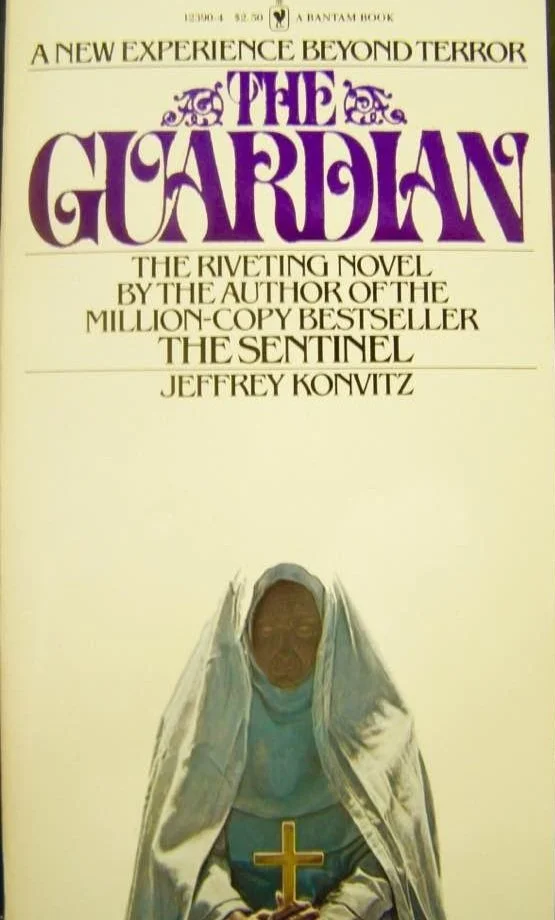
Following the commercial success of his novel The Sentinel, Jeffrey Konvitz penned a sequel entitled The Guardian. Released in 1978 and still riding high off the widespread success of the 1977 adaptation of the first novel, The Guardian managed to sell out completely within just 10 days. But did the second novel in this stalled trilogy earn its praise? I had to see for myself.
Right off the bat, Konvitz seems to have learned a lot from his previous effort at storytelling. Where The Sentinel might have had issues with drawing the reader into the plot, The Guardian takes a more direct approach. Introducing the reader first to a homosexual partnership and then a couple who takes up residence in a newly constructed apartment building. Leading the reader into a tangled web of mystery as the religious horror novel unfolds.
Still, where Konvitz has learned how to accelerate his plot and invest his readers earlier, he begins to falter when it gets deeper into the story. Right where the climax is meant to take off and bring the novel to a heightened peak of excitement, Konvitz chooses to drop a bombshell of a twist on the readers. One that this writer feels was undeserved.
One of the key elements of storytelling I’ve learned from undergrad is that the best twists are the ones a reader may look back on and see where indicated all along. Their clues might have been minute, but their presence was still there all along. Konvitz, on the other hand, barely gives the reader any clues that this twist is coming. The result is that it came across more as a dirty trick to the reader than a well-deserved twist. If Konvitz had only fleshed out more of his storytelling skill with an eye towards detail, he might not have needed the three different titles (The Sentinel II, The Apocalypse, and The Guardian) this work was printed under to generate greater popularity.
At the same time, what unique flair this series held with its first tale I felt was lacking with the second. One of the toughest things about writing any kind of sequel, in my personal experience with storytelling, is trying to set the sequel apart as its own story, its own world, and with its own cast of unique characters. Donald Maass, author of Writing the Breakout Novel, describes any series as requiring forward momentum. Meaning that it needs to reach new levels of danger and bigger stakes as well as presenting an arch of transformation from where the beginning of the original text begins and where the sequel(s) take us.
While The Guardian tries to incorporate some new characters, it falls flat with capturing a story that’s wildly different from The Sentinel. Without setting itself apart, its story offers no room for growth. In doing so, Konvitz ends up writing himself into a corner where he almost rewrites his original novel rather than upping the ante. It’s a shame because, as much as I loved reading it, I wanted more. As a reader, I wanted to see further development from a plot point of view. And if a novel is released under a title such as The Apocalypse, I’d like to see it delve deeper into the danger of the end of the world. Because, as a writer, a title should be chosen which appropriately reflects the kind of story being told. Not out of sensationalism.
This isn’t to say that I didn’t enjoy the novel. Jeffrey Konvitz’s The Guardian is wonderfully entertaining—just not for the reasons I was hoping it would be. It’s still worth a read for anyone interested in learning from the mistakes of other writers. Or anyone looking for an entertaining story of religious horror fiction.