The Sentinel

The Sentinel
By Jeffrey Konvitz
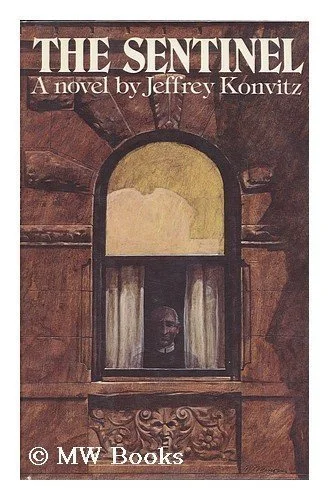
In my efforts to branch out in my horror reading adventures, I decided to dive into the 1974 novel The Sentinel by Jeffrey Konvitz. Written as the first installment of a stalled trilogy by a first-time writer, this book’s popularity exploded when it originally hit the market with both a paperback rights and movie deal. Sadly, despite its immense initial commercial success, the book has since gone out of print, making it a lesser-known religious horror gem by a writer who eventually went on to become a film industry executive because of this success.
On the surface, The Sentinel begins with a mystery of its own—a file on a woman named Alison—who is watched by an unspecified person for reasons which aren’t clear. It’s only when Konvitz draws the reader in by introducing Alison as our protagonist that the reader begins to settle into the story. But by the first benchmark in its storytelling, there’s still no indication of what is actually going on with the unseen “watcher.” Instead, the reader becomes entwined more with Alison’s backstory and medical issues, how specifically they all tie together.
This is a rookie mistake, I feel, because the art of fiction relies primarily on patterning. When I was a student at VCFA, I had a workshop with Douglas Glover who taught us a basic formula for the craft of fiction: Desire/Resistance=Story. This basically means that the act of storytelling relies on the repetition of a character wanting something and the conflict (or resistance) which ultimately acts against the character until there is a shift in character which changes the response to the conflict, thus creating a resolution. But if we apply this logic to Konvitz’s novel, what is it that Alison wants besides an average life as a model and a relationship with her boyfriend? Sure, the writer begins to delve into her character with relationship tensions between her and her lover, Michael, as well as her attempts to cope with her guilt surrounding past traumas, but is it enough? I’m not so certain.
The result is that, while this novel might have been fine as a film script, translated into a novel medium its focus became fuzzy. It was only when the truly absurd occurrences began (as the mystery of the brownstone and the elderly priest upstairs unfolded) that the writing truly launched the plot into forward momentum. But I can excuse this as Konvitz’s inexperience, as this novel was originally pitched as a horror film before it was written.
Regardless, where Konvitz struggles with pacing and focus, he makes up for it with his originality and detail. His concept—the kind of religious horror story he’s telling—is unique in its execution making it a brave attempt, especially for a first-time writer. And the manner in which he interweaves his religious references and subtle nods to Catholicism only further enriches the text of this novel, thus making this story a truly exquisite piece of fiction in its own light. Leading the reader to an ending which, to me, was unpredictable at its core.
Despite its structural shortcomings, The Sentinel remains to be a truly unique tale of religious horror fiction and a guide for any first-time writer who struggles with exposition. I found this novel highly enjoyable and wonderfully brave for a first effort. I’m curious to know how his skills developed with this book’s sequel—The Guardian.