The Other Emily

The Other Emily
By Dean Koontz
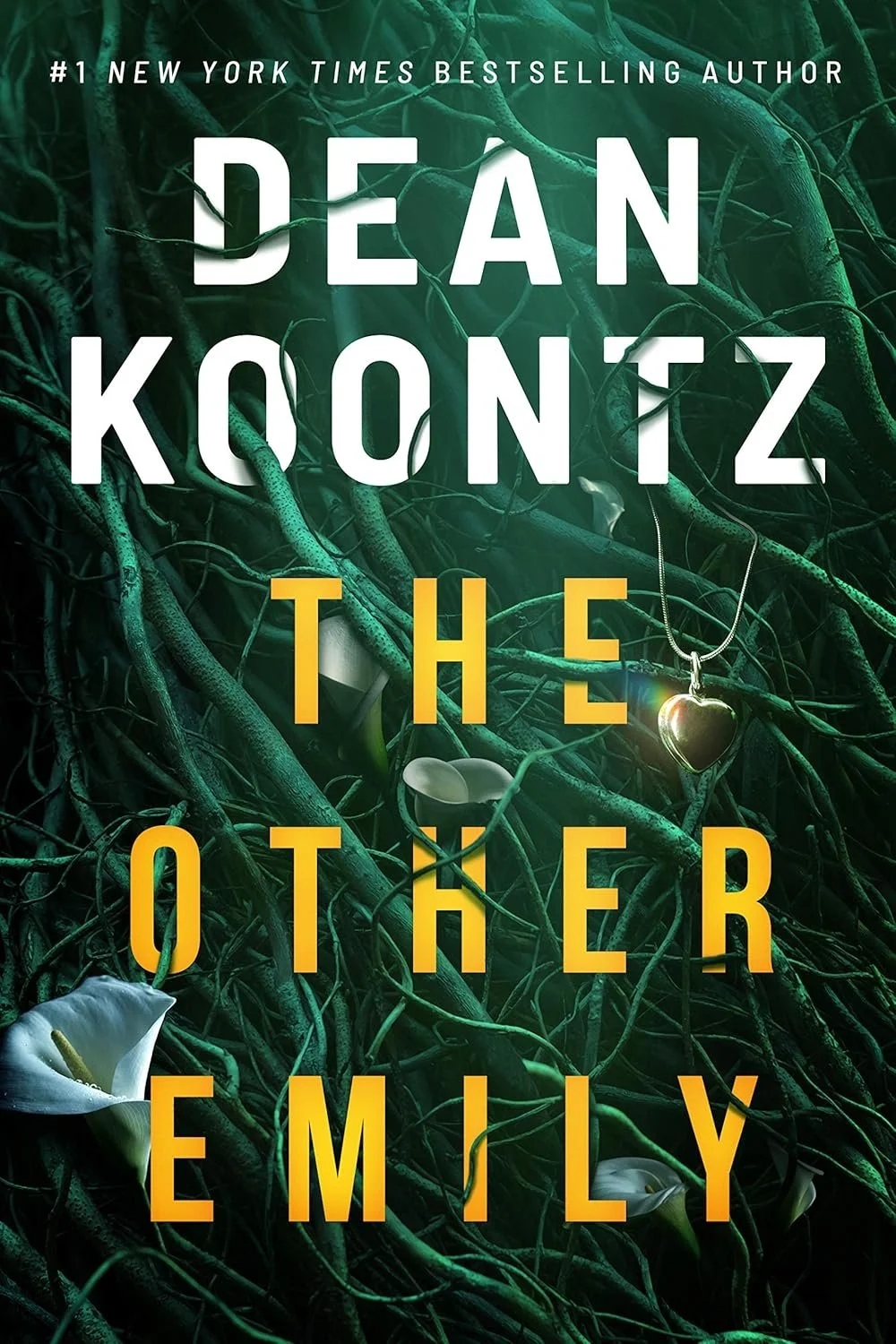
During my recent literary adventures, I realized that I’ve never read a Dean Koontz novel. So I decided that just won’t do. I just finished reading The Other Emily, and for a first experiment reading Koontz, I found it to be an interesting experience.
Koontz unfolds the novel by introducing a writer heartbroken and haunted by the memory of a woman he still loves whom he believes was the victim of a serial killer. Only one night at dinner out, he encounters a mysterious woman who looks and sounds and acts exactly as the lady he misses. And that’s just the beginning. Koontz goes from first to fifth gear as he propels his protagonist through the mystery of not only what happened to his beloved years ago but also the truth about the new woman. Koontz weaves a tale that’s part Silence of the Lambs, part romance, and tied together with artfully described suspense.
I can say from the start that this novel does several things very well. Koontz is able to establish his protagonist with ease, particularly through the close third point of view. The story unfolds written in beautifully poetic language, drawing the reader in quickly. Doug Glover had once written in an essay on craft that a protagonist’s occupation within a story should at least in some way influence the character’s outlook within the tale. Koontz accomplishes this quite beautifully. His protagonist—David Thorne—is a writer himself, and this is more than believable because of the way the point of view is shaped by careful diction. Several times I found myself getting lost in the beauty and the rich darkness that Koontz depicts within his novel’s world.
It’s not only the protagonist Koontz does well with describing. Although Emily Carlino—his missing love interest—is more or less an empty space due to her function and circumstance, Koontz layers enough detail about her through memories of her relationship with Thorne as a means to give her presence. He’s also able to successfully characterize her through Maddison Sutton—the mysterious woman who could be her doppelganger. The result is that she is as much of a living, breathing person within the confines of the written pages as Thorne is.
Where Koontz struggles, however, is with his secondary character cast. The serial killer Thorne keeps in contact with throughout the years in his attempt to discover what became of Emily I found particularly problematic. Thomas Harris had been innovative when he’d first wrote a complex and sophisticated serial killer (Hannibal Lecter) in his novels. Since then, the idea of a cordial killer being terrifying has been mimicked in many different movies and novels over the years. And to be honest, unless it’s done particularly well to the point that you’re left no alternative but to believe it, I find this to be more cliché and ridiculous. While Koontz gets some of the psychology right, his character falls flat. Out of all the characters, I disliked this one the most.
That being said, while his secondary characters required his keen eye for edits, I almost wish that he didn’t make his protagonist so successful. While David Thorne is a rich, emotionally deep character, I didn’t want him to be a wealthy writer. Like the serial killer cliché, a novelist being wealthy in fiction is equally cliché. The man drives around for most of the book in a Porsche Cayenne SUV and seems to feel money is no object. What would it look like if funds were different? How would that have influenced the trajectory of his journey? These were things I found myself wanting to know.
More vital, however, when it came to flaws is that the twists were too much of a sharp turn. One of the cardinal rules of writing a twist in any work of fiction is that the clues all have to be laid out for the reader to guess it. If they aren’t, the twist is undeserved and becomes a dirty trick. While Koontz strategically places enough clues that the reader can guess what will be revealed, the problem is that the twists didn’t fit the rest of the novel’s progression. Perhaps three quarters of the book are so tightly knit that the reader expects the last section to be strange but rooted in some basis of realism. Instead, Koontz almost takes the last section as a challenge to see how far he can bend his narrative until it’s ready to break. The result is that this novel reads like two separate plots Koontz attempted to weld into one. And while it works enough to get the job of being a story done…it doesn’t work enough to make it a truly great novel the way I wanted it to. As a reader (and especially a writer) I wanted better.
Overall, The Other Emily by Dean Koontz might not be your favorite newer horror novel, but it will be sure to hook you and keep you wondering what might happen next. This book has made me curious about how Koontz approached his other novels, so I can say that it won’t be my last adventure into his fiction. For now, however, I’d like to recommend this novel to anyone interested in mystery and science fiction or to any writer wanting to see both how to properly execute a twist and just how far not to bend the twist you write.
I look forward to another Koontz adventure, hopefully soon.