Brave New World

Brave New World
By Aldous Huxley
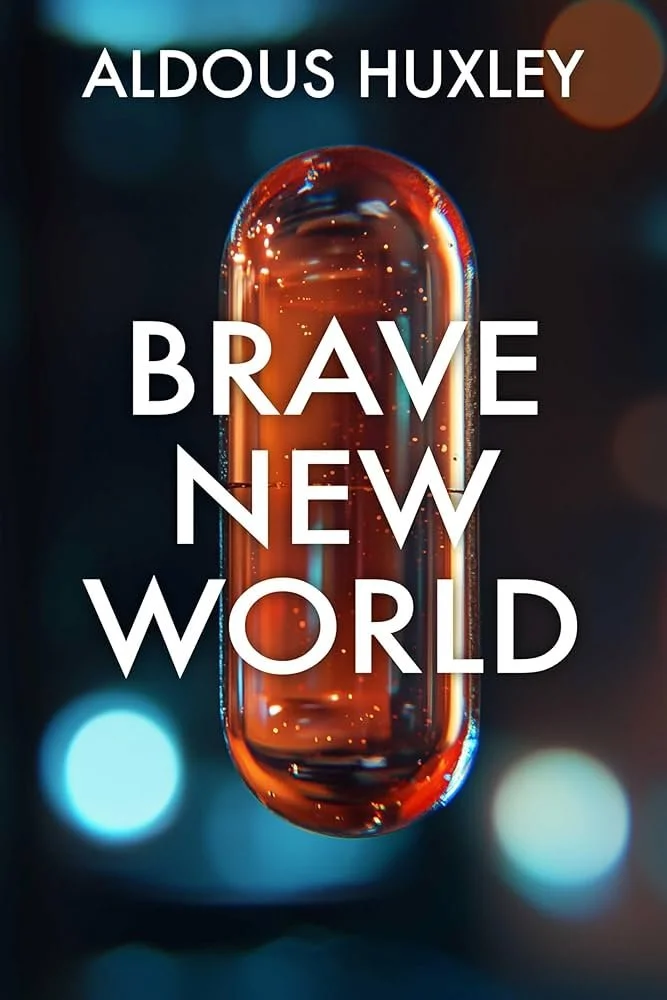
It is seldom that a dystopian novel reaches the status of classic; of the few that have, there are two most people think about when they consider a utopian future. The first is George Orwell’s 1984. The second is even older—Aldous Huxley’s 1932 novel Brave New World. Having read the former before, my curiosity finally got the best of me and spurred me to read the latter.
On the surface, Huxley’s book is a very simple story as it follows a man named Bernard and his navigation of a World State society and how that changes when he encounters someone whom had been completely cut off from it. But when examined closer, the reader sees just how Huxley shaped the dystopian genre with his structure of society. Instead of a tried-and-true craft method of government oppression (as with Orwell’s work), Huxley instead chooses to examine it through the lens of pleasure through careful conditioning. This is a brave choice, as it dares to ask the question, “What if there was no motivation to write about or think about anything ever again?”
A very scary question, indeed.
But, as stated, a brave choice in the manner that it can be difficult to execute if not handled with care. In Huxley’s case, while his execution of such a world works on the page, I feel like it didn’t engage enough with the society where it counted. There was plenty of world-building in the beginning—to the point that society itself became a character—but when it came time to for the characters (especially the star character) to interact with it, Huxley opted to pack in more summarization than actual scene depth. The result, to me, was that while the book had some wonderful thematic moments and beautiful passages of introspection, Brave New World almost folded in on itself as a story.
I wanted to love this book, but it was for that reason most of all that I found it cumbersome. While I absolutely loved its thematic message and carefully constructed exchanges where the ideas of control and pleasure seeking were carefully debated, I felt like it could have gone a step further in craft execution. If it hadn’t been such a slow build up to a quick climax and conclusion, there could have been greater focus on the star character’s encounters throughout the world (making more space for deeper thematic passages). That could have driven the point home in a more powerful way for the reader, thus making the ending that much more deserved and gut-wrenching.
Although it’s not a classic that I would read again, I feel like it’s important for what point it’s making. Brave New World is the kind of timeless tale (thematically) which forces us to take a hard look at our current reality. Several times I found myself drawing similarities between the world Huxley described and our own. Wondering every time just how far around the corner such a dystopian society may be. In some regards, I fear it may be closer than we imagine.
I’d recommend reading Brave New World at least once in your life, even if you wind up liking only pieces of it like I did. It’s the kind of novel that makes you mad—which is exactly what any good work should do.